The MEA spokesperson did not reply to questions like whether the US had approached India with the offer, whether New Delhi has communicated its response over it to Washington, DC or whether the Trump administration has been briefed about the current standoff between Chinese and Indian soldiers in eastern Ladakh.

The Indian Army will continue to maintain its aggressive posturing in all disputed areas in eastern Ladakh and will not back off till status quo is maintained, sources said.

At least a couple of Chinese military helicopters were spotted flying close to the un-demarcated Sino-India border in the area after the fierce face-off on May 5 following which a fleet of Sukhoi-30 jets of the Indian Air Force too carried out sorties there, the sources said.

China on Sunday said the border dispute with India has been "contained" and the Indian elephant and Chinese dragon should "do more" to strengthen the bilateral cooperation to facilitate its settlement.

In a stern message to its neighbours, China today said it is determined to defend "every inch" of its territory and there was "no room for compromise" with Japan over territorial or historical disputes.
The 16th round of India-China border talks will be held in Beijing on June 28 followed by the visit of Defence Minister A K Antony a week later as the two countries are set to resume top level contacts to build on the recent visit of Chinese Premier Li Keqiang to New Delhi.
While the de-escalation process was underway, a violent face-off took place on Monday night between Indian and Chinese troops leading to the death of 20 Indian soldiers.

The enhancement of combat capability by the two armies in the region came even as both the countries continued their efforts to resolve the dispute through talks at military and diplomatic levels.
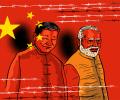
'It is time we Indians stop our internal bickering and present a united front to Chinese machinations,' advises Colonel Anil A Athale (retd).
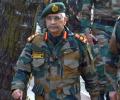
The commanders will also deliberate on the overall situation in Jammu and Kashmir besides delving into issues having national security implications, they said. However, the main focus will be on the situation in eastern Ladakh where Indian and Chinese troops are locked in an eyeball-to-eyeball face-off in Pangong Tso, Galwan Valley, Demchok and Daulat Beg Oldie, the sources said.

The Indian Army has been matching up to the Chinese build up in both Pangong Tso lake and Galwan Valley, the two locations in Ladakh which have witnessed major reinforcement of troops in the last two weeks, sources said. There was very little chance of easing of tension anytime soon as both sides are aggressively holding onto their respective positions, they said.
On May 5, around 250 Indian and Chinese army personnel clashed with iron rods, sticks, and even resorted to stone-pelting in Pangong Tso lake area in Eastern Ladakh.

The army chief said that India needs to broaden its understanding of national security and must examine non-traditional threats like pandemics "de-novo" as they have the potential to inflict severe damage on the country. "We need to act and prepare ourselves accordingly."
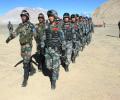
The talks between the two armies are going to be held this week at multiple locations including Patroling point 14 (Galwan area), Patrolling point 15, and Hot Springs area, top government sources said.
Indian military sources said no firearms were used in the clashes and that most of the injuries were sustained following stone-pelting and use of rods by the Chinese side.

'Does the Indian army's new assertiveness risk a clash escalating into shooting and possibly skirmishes?' asks Ajai Shukla.

Xi will attend the second informal meeting with Modi at Mahabalipuram near Chennai from October 11 to 12 and pay a state visit to Nepal on October 13, Foreign Ministry spokesperson Hua Chunying announced on Wednesday.
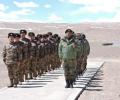
The US hopes that the differences will be resolved peacefully, officials said in Washington.
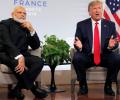
Trump on Wednesday said in a tweet that he was "ready, willing and able to mediate" between the two countries.
Indian and Chinese troops remained engaged in an eyeball-to-eyeball situation in several disputed areas.
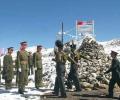
People familiar with the situation in the region said the two sides were engaged in trying to resolve the dispute, but there was no indication of a positive outcome yet as both the armies continued to bolster their positions in disputed areas of Pangong Tso and Galwan Valley and Demchok.
It is learnt that the India's top military brass is constantly monitoring the evolving situation even as the United States said the aggressive behaviour by Chinese troops was a reminder of the threat posed by China.

Special Representatives of India and China will hold the 16th round of boundary talks in Beijing on Friday, the first such meeting under the new Chinese leadership, to make another bid to move forward on the resolution of the vexed dispute.

The talks came a day after the two armies began a limited disengagement in a few areas in Galwan Valley and Hot Spring in a demonstration of their intent to end the row peacefully.
The Indian delegation led by Lt General Harinder Singh, the general officer commanding of Leh-based 14 Corps, and Commander of the Tibet Military District Maj Gen Liu Lin held an extensive meeting in Maldo on the Chinese side of the Line of Actual Control in eastern Ladakh on Saturday that began at around 11.30 am and went on till evening.
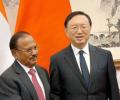
National Security Advisor Ajit Doval and his Chinese counterpart Yang Jiechi will meet in Hyderabad in November first week for informal dialogue on the state of bilateral relations

'The government will ensure that India's pride is not affected as far as the situation along Indo-China border is concerned'

"CCP's (Chinese Communist Party) territorial aggression is also apparent on its Indian border where China has attempted to seize control of the Line of Actual Control by force," US National Security Advisor Robert O'Brien said in a remark on China early this week in Utah.

'For this kind of informal summit, I think it is better to leave the leaders much time to discuss whatever they would like to discuss'

India on Wednesday delivered a strong message to China that the 'unprecedented' incident in the Galwan Valley will have a 'serious impact' on the bilateral relationship and held the 'pre-meditated' action by Chinese army directly responsible for the violence that left 20 Indian Army personnel dead.
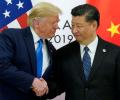
"We are capable of properly resolving the issues between us through dialogue and consultation. We do not need the intervention of the third party", he said.
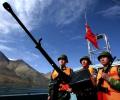
The Chinese side has particularly bolstered its presence in the Galwan Valley, erecting around 100 tents in the last two weeks and bringing in heavy equipment for construction of bunkers, notwithstanding the stiff protest by Indian troops. There have been reports of multiple incidents of transgressions by Chinese troops in several areas in Eastern Ladakh.
Both the Indian and Chinese armies have brought in more troops in sensitive locations like Demchok, Daulat Beg Oldie and areas around Galwan river as well as Pangong Tso lake in Ladakh, the sources said. The area around Galwan has been a point of friction between the two sides for over six decades.

'A participant in many rounds of the border talks with China once told me that China seemed not interested in resolving the border issue as it wanted to keep it as a ready excuse to intervene in the sub-continent,' says Colonel (retd) Anil A Athale.

This was the first round of talks for Wang after he succeeded State Councillor Yang Jiechi earlier this year.

China said on Monday it regretted that two Indian athletes were blocked last week from going to China but defended measures it has put in place in response to a border dispute which led to the ban on the pair travelling.
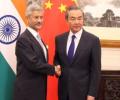
Wang said the two sides should follow the important consensus reached by the leaders of the two countries and strengthen the communication and coordination on the proper handling of the border situation through the existing channels so as to jointly maintain peace and tranquility in the border area, the Chinese foreign ministry said in a statement.
The MEA said it was the Chinese side that recently undertakook activities hindering India's normal patrols in the areas.

'As for tricky relations with China, India needs less of summitry type event management and more anticipatory analysis and management of events,' says Ambassador Jaimini Bhagwati.

Four Chinese soldiers were killed in the fierce clash with the Indian Army in the Galwan Valley in eastern Ladakh in June last year, the People's Liberation Army (PLA) acknowledged for the first time on Friday.
